Pipeline

Transforming the treatment of disease with highly selective therapeutic antibodies.

The Selectivity Challenge

Existing therapeutics indiscriminately kill both healthy and diseased cells

Solid tumours are hard to treat because, in the majority of instances, they can only be targeted by antibodies using tumour-associated antigens (TAAs). Healthy cells that also express these TAAs are caught in the crossfire, resulting in on-target, off-tumour toxicity.
Tackling On-target, Off-tumour Toxicity

Unlocking killing selectivity through avidity

The biological mechanism that we’ve used to achieve killing selectivity is based on the principle of avidity. By harnessing avidity-driven selectivity, our optimised T-cell engagers are able to differentiate between a healthy and diseased cell based on differential TAA expression.

Conventional methods marginally widen therapeutic windows

Conventional Methods

LabGenius’ approach delivers complete on/off killing selectivity

LabGenius' approach

Programme

Indication

Development Stage

Programme

Indication

Lead Discovery
Lead Optimisation
Candidate Selection
IND-enabling studies
Clinical Phase 1

Programme:

LGTX-101
Nectin-4 x CD3 TCE

Indication:

Nectin-4+ solid tumours

Stage: IND-enabling studies

Nectin-4 is a tumour-associated antigen (TAA) that is commonly overexpressed on numerous solid tumour types, including urothelial, head and neck, and triple-negative breast cancer. Nectin-4 is also expressed at low levels on normal, healthy tissues, which limits current ADC therapies due to high rates of dose-limiting, on-target, off-tumour toxicities. This highlights a need for alternative approaches for anti-cancer therapeutics that can selectively target Nectin-4 expressing solid tumours. 

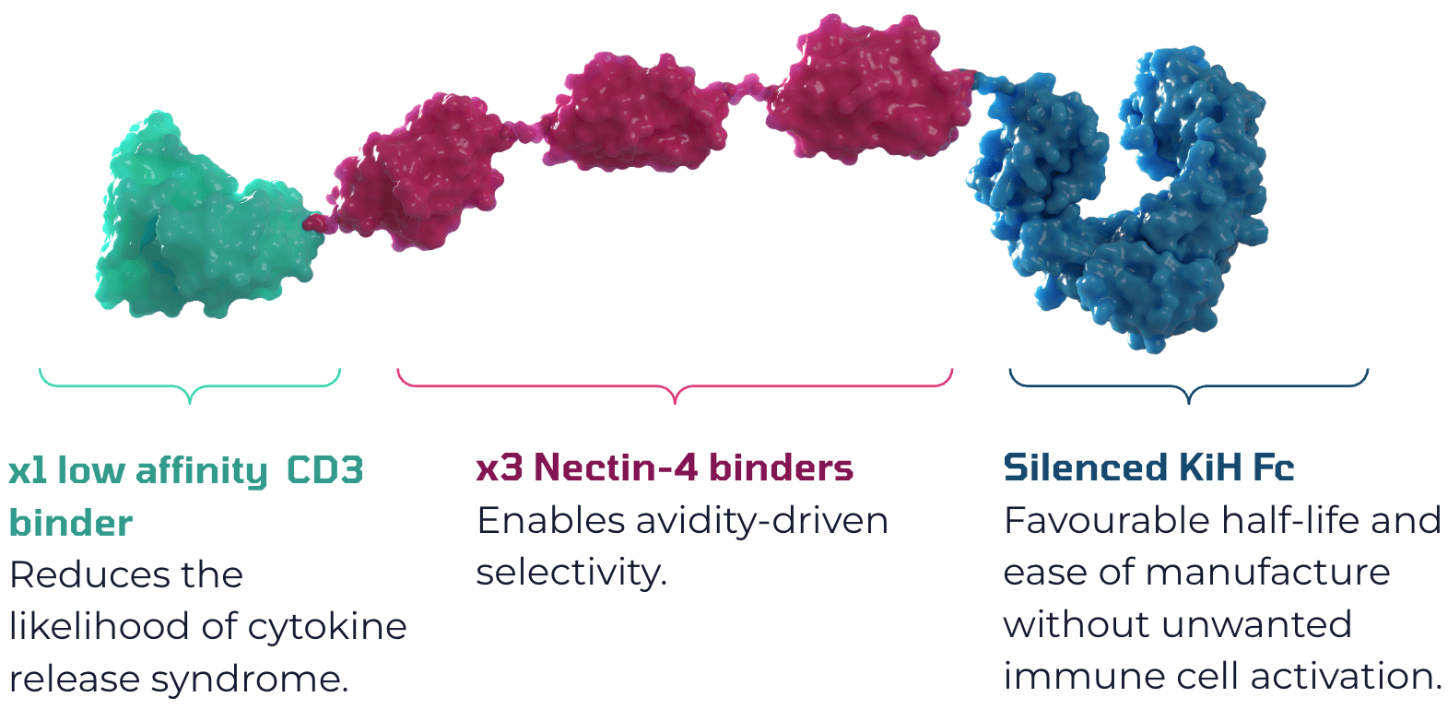
Through the tight integration of high-throughput functional cell-based experimentation with machine learning (ML), LabGenius’ proprietary lead optimisation platform (EVA™) generated a highly selective and potent trivalent VHH-based Nectin-4 x CD3 T-cell engager (TCE), LGTX-101. By harnessing avidity-driven selectivity, LGTX-101 is able to differentiate between healthy and diseased cells based on differential TAA expression, demonstrating >70,000-fold killing selectivity in a T-cell-mediated tumour cell killing assay. LGTX-101 is highly efficacious in vivo with complete tumour regression observed in all tumour-bearing mice treated with our lead candidate.

LGTX-101 has a highly novel 3+1 architecture that combines:

Programme:

LGTX-201
AND-gate TCE

Indication:

Solid tumours

Stage: Candidate Selection

Partner:

Indication:

Various

Stage: Lead Optimisation

Programme:

Avidity-driven TCE +co-stimulatory arm

Indication:

Solid tumours

Stage: Lead Discovery

Partner:

LG Chem logo: red circular emblem with white curved line and dot, followed by gray 'LG Chem' text.

Indication:

Solid tumours

Stage: Lead Discovery

Programme:

Logic-gate TCEs

Indication:

I&I

Stage: Lead Discovery